Explain xargs code
Paste a find | xargs line and Vibe explains how file names become arguments: what -0, -n, -P, -I {} and -r do, and why a space in a file name breaks the plain version.
Up to 1,500 characters (about 60 lines). Your code is sent to Unvibe and Anthropic to write the explanation. Don't paste keys or passwords. Common key formats are refused.
Vibe14 lines selected
Press Explain it for the sample, or paste your own code first.
What this xargs sample shows
- -print0 and -0
- xargs reads names from its input and adds them to the end of the command.
-print0ends each name with a NUL byte and-0splits only there, sojobs 2.logstayed one name. The last line has neither, and xargs split on the space: ls got./errorandlog.log, printedcannot accessfor each, and xargs exited with code 123. A file named it's.log stopped plain xargs withunmatched single quote. - -n and -P
-n 1gives each command one name, so the 5 old logs ran gzip 5 times. Without-n, xargs ran one gzip with all 5 names.-P 4runs up to 4 commands at once: 5 jobs that each sleep 1 second took 2.0 seconds with-P 4and 5.0 with-P 1. Output can mix: the-vlines of 4 gzips came out tangled on one line.- -I {}
-I {}runs one command per name and puts the name where{}is, here in the middle, becausemvneeds the folder last. All 5 .log.gz files ended up in archive/,jobs 2.log.gzincluded, while the 2 newer logs stayed where they were.- -r on empty input
- With no .tmp files, find printed nothing, and GNU xargs still ran
rm -vonce with no names: rm printedmissing operandand xargs exited with code 123. With-r, nothing ran and the exit code was 0, which matters in a script that stops on the first error.
Good to know
- Run with GNU findutils 4.11.0 (find and xargs) and gzip 1.14 on Linux, in a test logs folder of 7 files: 5 last changed 10 days ago,
jobs 2.logamong them, and 2 new ones,error log.logand today.log. - The xargs in macOS is a BSD version. Its manual in Apple's source (github.com/apple-oss-distributions/shell_cmds, shell_cmds-329) says it doesn't run the command on empty input, and that
-ris accepted there but does nothing.
Watch out: Plain find | xargs rm can delete the wrong file. In a folder with a file named keep and a file named keep me.tmp, find . -name '*.tmp' | xargs rm -v printed removed './keep', then cannot remove 'me.tmp'. The .tmp file was still there and keep was gone. Use -print0 with -0 every time a command deletes or moves files.
Explain xargs code beside your editor
Unvibe is a free app for Mac and Windows. In the app there is no pasting: select code in any app and press Control+U (Ctrl+Alt+U on Windows).
Install on Mac
curl -fsSL https://unvibe.site/install.sh | bashPaste into Terminal. Unvibe isn't notarized by Apple yet, so this is the smooth path.
Or download the .dmg · Intel Mac build · SHA-256 checksums
Opening the .dmg the first time
- Open the .dmg and drag Unvibe to Applications.
- Open it once; macOS says it can't verify it. Click Done.
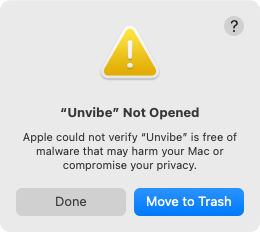
Real screen, macOS 15 - System Settings › Privacy & Security › Open Anyway. Confirm, then enter your Mac password. The button shows for about an hour after you try to open Unvibe.
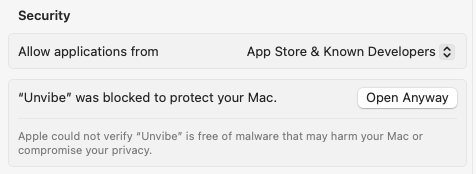
Real screen, macOS 15
The Terminal line checks the download against the published SHA-256 and Unvibe's self-signed signature before it installs anything. More help with the first open