Explain tar code
Paste tar commands and Vibe explains what each letter does: what c, x, t, z, v and f mean, where the files end up, and which mistakes the command won't stop.
Up to 1,500 characters (about 60 lines). Your code is sent to Unvibe and Anthropic to write the explanation. Don't paste keys or passwords. Common key formats are refused.
Vibe15 lines selected
Press Explain it for the sample, or paste your own code first.
What this tar sample shows
- c, t and x
- The first letter says what tar does:
ccreates an archive,tlists what's in one andxextracts it. On a folder holding package.json, src/index.html, src/app.js, node_modules and server.log,-tzflisted 5 entries:my-site/,my-site/package.json,my-site/src/, and the 2 files in src. The listing wrote no files. - z, v and f
zruns the archive through gzip,vprints each file as tar works, andfnames the archive file, so the name must come straight after it. Writtentar -cfz x.tar.gz my-site, tar tookzas the archive's name: it made a file calledzand failed onx.tar.gz: Cannot stat: No such file or directory.- -C and --exclude
--excludepatterns kept node_modules and server.log out of the archive. GNU tar only applies them when they come before the folder: put aftermy-site, it said--exclude ‘node_modules’ has no effect, exited with code 2 and still packed node_modules.-C ~/restoreunpacked into ~/restore, so the files landed in ~/restore/my-site. With a folder that didn't exist, GNU tar stopped withCannot open: No such file or directory.- one file out
- A name after the archive extracts only that member, written exactly as
-tlists it:my-site/package.json, notpackage.json. A name that wasn't in the archive gaveNot found in archive. A pattern like'my-site/src/*.js'found nothing in GNU tar until--wildcardswas added. bsdtar extracted app.js without it, and refused--wildcardsas an option it doesn't support.
Good to know
- Run with GNU tar 1.35, and with bsdtar 3.8.9 from libarchive. The tar in macOS is Apple's own, older build of bsdtar (github.com/apple-oss-distributions/libarchive). Both packed the same 5 entries from the sample. GNU tar's
vprinted plain names, and bsdtar's putabefore each file it added andxbefore each file it extracted. - Where they differ:
-xzfon a plain .tar stopped GNU tar withgzip: stdin: not in gzip format, while bsdtar unpacked it. Both unpacked the .tar.gz with-xfand noz, because each works out the compression itself when reading.
Watch out: Extracting overwrites files with the same name, without asking. After package.json in ~/restore was changed, extracting the archive into ~/restore again put the archived version back, with no warning and exit code 0. Add -k to keep files that already exist: GNU tar then refused each one with Cannot open: File exists, and bsdtar skipped them silently. Unpack into an empty folder when you aren't sure what's in an archive.
Explain tar code beside your editor
Unvibe is a free app for Mac and Windows. In the app there is no pasting: select code in any app and press Control+U (Ctrl+Alt+U on Windows).
Install on Mac
curl -fsSL https://unvibe.site/install.sh | bashPaste into Terminal. Unvibe isn't notarized by Apple yet, so this is the smooth path.
Or download the .dmg · Intel Mac build · SHA-256 checksums
Opening the .dmg the first time
- Open the .dmg and drag Unvibe to Applications.
- Open it once; macOS says it can't verify it. Click Done.
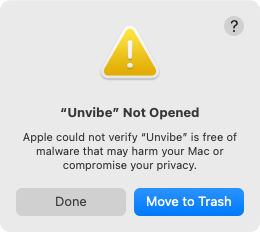
Real screen, macOS 15 - System Settings › Privacy & Security › Open Anyway. Confirm, then enter your Mac password. The button shows for about an hour after you try to open Unvibe.
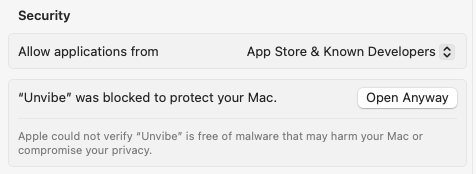
Real screen, macOS 15
The Terminal line checks the download against the published SHA-256 and Unvibe's self-signed signature before it installs anything. More help with the first open