Explain systemd service code
Paste a systemd unit file and Vibe explains what each line does: what ExecStart= runs and where, which exits Restart= brings back, and where the Environment= values come from.
Up to 1,500 characters (about 60 lines). Your code is sent to Unvibe and Anthropic to write the explanation. Don't paste keys or passwords. Common key formats are refused.
Vibe17 lines selected
Press Explain it for the sample, or paste your own code first.
What this systemd service sample shows
- [Unit], [Service] and [Install]
[Unit]names the service and sets its order,[Service]says what to run and how, and[Install]is ignored while the service runs:systemctl --user enableanddisableread it (systemd.unit). Enabling it created a link to the file in default.target.wants, the list of what your user session starts.systemd-analyze --user verifyprinted nothing for this file and exited with code 0.- WorkingDirectory= and ExecStart=
ExecStart=is the command, with the full path to the program.%his your home folder, so python3 started in ~/apps/notes-api and found app.py there. With that folder missing, systemd printedChanging to the requested working directory failedandFailed at step CHDIR, then scheduled a restart because ofRestart=on-failure, which failed the same way.- Environment= and EnvironmentFile=
Environment=set APP_ENV=production and PORT=8040, and the app reported both. A .env file withPORT=8041won over that line: the app moved to 8041 and 8040 stopped answering. The-before the path makes the file optional. Without it, a missing .env stopped the start withFailed to load environment files: No such file or directory.- Restart= and RestartSec=
Restart=on-failurebrings the service back when it exits with an error. When the app exited with code 1, systemd loggedstatus=1/FAILURE, thenScheduled restart job, restart counter is at 1, and after the 2-secondRestartSec=wait a new process, with a new PID, answered. When the app exited with code 0, it stayed stopped, because a clean exit isn't a failure.
Good to know
- Run with systemd 261 and Python 3.14.7 on Linux as a user service, with no root:
systemctl --user linkpointed systemd at the file andsystemctl --user start notes-apistarted it. app.py is a short test server that reports its settings and exits with code 1 or 0 on request. - After an edit to the file,
systemctl --user statuswarned that the unit filechanged on diskand said to runsystemctl --user daemon-reloadto load the new version. After=network.targetdoes nothing in a user service.After=only sets the order and doesn't start anything by itself (systemd.unit), and network.target belongs to the system service manager: it isn't in the user manager's list of units (systemd.special), andsystemctl --user show network.targetprintedLoadState=not-found. default.target is the main target of the user service manager (systemd.special).
Watch out: Restart=on-failure gives up on a service that keeps crashing. With RestartSec=0 and the app crashing each time it came back, systemd restarted it 4 times, refused the 5th with Start request repeated too quickly and left it failed, with nothing on port 8040. This file doesn't set a limit, so systemd's defaults applied: 5 starts in 10 seconds (StartLimitBurst= and StartLimitIntervalSec=). After fixing the cause, systemctl --user reset-failed notes-api clears that state so you can start it right away.
Explain systemd service code beside your editor
Unvibe is a free app for Mac and Windows. In the app there is no pasting: select code in any app and press Control+U (Ctrl+Alt+U on Windows).
Install on Mac
curl -fsSL https://unvibe.site/install.sh | bashPaste into Terminal. Unvibe isn't notarized by Apple yet, so this is the smooth path.
Or download the .dmg · Intel Mac build · SHA-256 checksums
Opening the .dmg the first time
- Open the .dmg and drag Unvibe to Applications.
- Open it once; macOS says it can't verify it. Click Done.
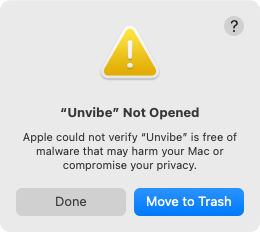
Real screen, macOS 15 - System Settings › Privacy & Security › Open Anyway. Confirm, then enter your Mac password. The button shows for about an hour after you try to open Unvibe.
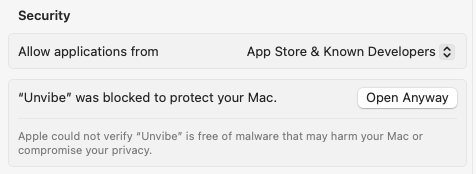
Real screen, macOS 15
The Terminal line checks the download against the published SHA-256 and Unvibe's self-signed signature before it installs anything. More help with the first open