Explain sed code
Paste a sed command or script and Vibe explains which lines each address picks, what a s/// swaps in and what \1 and \2 hold.
Up to 1,500 characters (about 60 lines). Your code is sent to Unvibe and Anthropic to write the explanation. Don't paste keys or passwords. Common key formats are refused.
Vibe22 lines selected
Press Explain it for the sample, or paste your own code first.
What this sed sample shows
- addresses
- A command can start with an address that picks the lines it runs on.
/^[[:space:]]*#/ddeletes every line whose first non-space character is#, anddalso stops work on that line, so a deleted line never reaches the later commands. Every other line runs through each command from the top, in order. - substitution
s/old/new/replaces the first match on each line, andgat the end replaces every match. On a line with two dates, the script rewrote both; the same command withoutgrewrote only the first and left2026-11-30as it was.- capture groups
- Brackets in the pattern save what they match, and
\1,\2and\3put it back in the replacement, so the year, month and day come back in a new order.-Eturns on extended regular expressions, where plain brackets capture and{4}means four times. Run without-E, sed stopped withinvalid reference \3 on 's' command's RHS. - ranges
/^\[server\]/,/^\[/picks every line from[server]to the next line that starts with[, and!turns it around, so!ddeletes everything outside that range. When[server]was the last section, the range ran to the end of the file.
Good to know
- Run with GNU sed 4.10 on a 13-line settings file, the script printed 7 lines:
[server],host = example.internal,port = 8080,api_token = [hidden],db_password = [hidden],started = 05/11/2026 09:14and[logging]. [logging]is still in the output because a range includes the line that ends it. That line starts with[, so it closes the[server]range and is kept with it.sed -iwrites the result back over the file instead of printing it, and-i.bakfirst keeps the original assettings.conf.bak. Run on a copy,-iwith no suffix left no way back to the comments.
Watch out: [a-z_]+ and (token|password) only match lowercase letters, so a line written API_TOKEN = abc came through as API_TOKEN = abc, with the secret showing and no error. Adding GNU sed's I flag after the last slash makes the match ignore case, and then it printed API_TOKEN = [hidden].
Explain sed code beside your editor
Unvibe is a free app for Mac and Windows. In the app there is no pasting: select code in any app and press Control+U (Ctrl+Alt+U on Windows).
Install on Mac
curl -fsSL https://unvibe.site/install.sh | bashPaste into Terminal. Unvibe isn't notarized by Apple yet, so this is the smooth path.
Or download the .dmg · Intel Mac build · SHA-256 checksums
Opening the .dmg the first time
- Open the .dmg and drag Unvibe to Applications.
- Open it once; macOS says it can't verify it. Click Done.
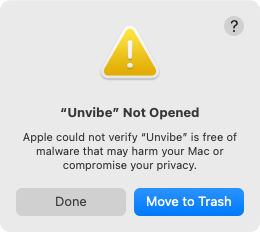
Real screen, macOS 15 - System Settings › Privacy & Security › Open Anyway. Confirm, then enter your Mac password. The button shows for about an hour after you try to open Unvibe.
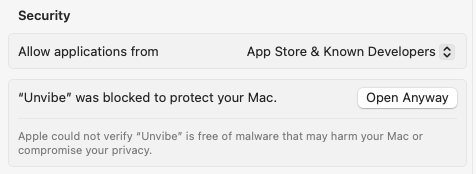
Real screen, macOS 15
The Terminal line checks the download against the published SHA-256 and Unvibe's self-signed signature before it installs anything. More help with the first open