Explain ps aux code
Paste what ps aux printed and Vibe explains each column: who owns a process, how much CPU and memory it uses, and what R, S, T and Z in the STAT column mean.
Up to 1,500 characters (about 60 lines). Your code is sent to Unvibe and Anthropic to write the explanation. Don't paste keys or passwords. Common key formats are refused.
Vibe11 lines selected
Press Explain it for the sample, or paste your own code first.
What this ps aux sample shows
- USER, PID and COMMAND
- Each row is one process: the account that owns it, its ID and the full command line, so
python3 -c while True: passtells 3 Python processes apart. PID 1 is systemd, which starts everything else. Names in square brackets like[kthreadd]are usually kernel threads, with 0 for VSZ and RSS; the zombie,[python3] <defunct>, gets brackets too. START is a clock time for recent processes and a date,Nov05, for older ones. TTY is?for a process with no terminal. - %CPU and TIME
99.2means the loop kept one CPU core busy. In procps, %CPU is CPU time divided by how long the process has existed, not what it is doing right now: a process that was busy for its first 3 seconds and then slept showed 49.8 at 6 seconds and 24.9 at 12. TIME,0:06for the loop, is its total CPU time so far.- VSZ and RSS
- Both are in KiB. RSS is memory actually in RAM: the list of 60 million items had 478368, about 467 MiB, and %MEM showed 2.9, its share of this machine's 16 GB. VSZ is address space the process has reserved, often far bigger: the Node server's VSZ was 1276360, about 1.2 GiB, with an RSS of only 53804. When something uses too much memory, look at RSS.
- STAT letters
- The first letter is the state:
Rrunning,Sasleep until something happens,Tstopped (that sleep gotkill -STOP),Za zombie, a process that has exited but whose parent hasn't collected it yet. Letters after it add detail:sleads a session,lhas more than one thread,Nruns at low priority and<at raised priority.
Good to know
- Run with ps from procps-ng 4.0.7 on Linux, on a machine with 12 logical CPUs and 16 GB of RAM. The account name in the sample is a placeholder, devuser, the same length as the real one, so the columns line up as ps printed them.
ps aux | greplists the grep as well, because its own command line contains the pattern: with 2 test processes running,grep 'psgreptest'returned 3 rows, one of them the grep.grep '[p]sgreptest'can't match itself, and returned only the 2.- In Apple's ps manual (github.com/apple-oss-distributions/adv_cmds, adv_cmds-237),
-ushows user, pid, %cpu, %mem, vsz, rss, tt, state, start, time and command, the same columns. ThereImarks a process asleep for more than about 20 seconds, while procps usesIfor an idle kernel thread.
Watch out: A zombie can't be killed: it has already exited. kill -9 on the zombie's PID left it in state Z, and it went away only when its parent, the Python process that forked it, was killed. If zombies pile up, the fix is in the parent, which has to wait for its children.
Explain ps aux code beside your editor
Unvibe is a free app for Mac and Windows. In the app there is no pasting: select code in any app and press Control+U (Ctrl+Alt+U on Windows).
Install on Mac
curl -fsSL https://unvibe.site/install.sh | bashPaste into Terminal. Unvibe isn't notarized by Apple yet, so this is the smooth path.
Or download the .dmg · Intel Mac build · SHA-256 checksums
Opening the .dmg the first time
- Open the .dmg and drag Unvibe to Applications.
- Open it once; macOS says it can't verify it. Click Done.

Real screen, macOS 15 - System Settings › Privacy & Security › Open Anyway. Confirm, then enter your Mac password. The button shows for about an hour after you try to open Unvibe.
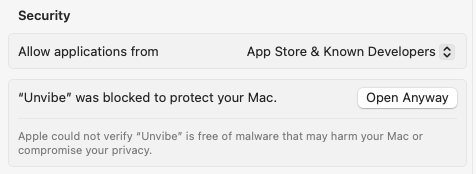
Real screen, macOS 15
The Terminal line checks the download against the published SHA-256 and Unvibe's self-signed signature before it installs anything. More help with the first open