Explain code in plain English
Paste a snippet, pick a depth and Vibe tells you what the code does. Free, no account.
Up to 1,500 characters (about 60 lines). Your code is sent to Unvibe and Anthropic to write the explanation. Don't paste keys or passwords. Common key formats are refused.
Vibe7 lines selected
Press Explain it for the sample, or paste your own code first.
Explain code by language
Each page starts with a real sample to explain, then notes on what it shows.
- Explain Python codeA timing decorator, a generator that reads a CSV file and a dict comprehension.
- Explain pyproject.toml codeA pyproject.toml for a small package: the setuptools build backend, name and version, the Python versions it supports, one dependency, a dev extra with pytest, a command called invoicer and pytest's settings.
- Explain requirements.txt codeA requirements.txt for a small Python app: requests pinned to one version, python-dotenv limited to 1.x, rich allowed any 15.x release, and tzdata only on Windows.
- Explain JavaScript codeLoading several users at once with fetch and Promise.allSettled.
- Explain jQuery codeA jQuery script that filters a product list as you type, keeps a count of what's shown and fades out an item when its Remove button is clicked.
- Explain TypeScript codeA generic Result type that a fetch helper returns instead of throwing.
- Explain tsconfig.json codeA tsconfig.json that compiles a small Node project from src/ to dist/ with strict checks, Node's own module rules, type files and source maps, and leaves test files out.
- Explain npm scripts codeA package.json with the usual npm scripts: dev with a file watcher, start, build with a prebuild step, test, lint with ESLint, one that chains two others and one that prints package fields.
- Explain ESLint config codeAn ESLint flat config: a build folder left out, the recommended rules, browser globals and three rules for src, and Node globals for scripts.
- Explain SQL codeRanking customers by this year's spend with a LEFT JOIN, GROUP BY and RANK().
- Explain GraphQL codeA named GraphQL query with two variables, one with a default: it asks for orders with their id, total, customer name and items, plus the signed-in user's name and email through a fragment.
- Explain git log codeThe output of `git log -2` and `git log --oneline --graph --decorate --all` for a small repo: two people's commits, a branch merged back into main and a release tag.
- Explain Bash codeA script that finds the 10 most common errors in a folder of logs.
- Explain PowerShell codeA PowerShell script that finds .log files older than a number of days, deletes them with WhatIf support and prints a size report.
- Explain curl codeA shell script with four curl calls to an orders API: a quiet GET that fails on errors, a JSON POST with a bearer token, a redirect saved to a file with its status code, and a DELETE that prints the response headers.
- Explain .bashrc codeA personal .bashrc: an interactive-only guard, history settings, your own folder first on PATH, two aliases, a make-and-enter folder function and a prompt that shows the git branch.
- Explain chmod codeA shell script that sets permissions before a deploy: numeric modes for a script, a config file, a secrets file and a private folder, then letter modes that add or remove one permission.
- Explain find codeA shell script with six find commands for a project cleanup: .log files, node_modules folders, files over 1 MB, files changed this week outside .git, line counts for .js files and deleting empty folders.
- Explain C codeAn array of structs allocated with calloc, filled in, used and freed.
- Explain C++ codeA function template, a class with a destructor and a unique_ptr that changes owner.
- Explain Swift codeA to-do list with a protocol, an optional due date, closures and a key path.
- Explain Ruby codeA class that mixes in a module and Comparable, then sorts and filters with blocks.
- Explain SQLite codeA SQLite script for a small shop: customers and orders tables with a foreign key, a CHECK and a default date, an index, a few rows and a spending report per customer.
- Explain Java codeA record for orders, a stream that totals paid orders per customer and a generic method that finds the top one.
- Explain HTML codeA sign-up form with a labelled email field, a hint, a group of radio buttons and two buttons.
- Explain CSS codeA grid of product cards, a flexbox column inside each card and a custom property for the sale color.
- Explain XML codeAn XML product catalog: a root element with a schema reference, two products with attributes, nested tags, an escaped ampersand and a CDATA description.
- Explain Markdown codeA README for a small command line tool: a title, bold text and a link, a numbered install list, a shell code block, a bullet list, a tip in a quote and a table of flags.
- Explain Go codeA function that parses each line in its own goroutine and returns the first error it receives over a buffered channel.
- Explain Rust codeA trait for stock that can be sold, a function that borrows the first available item and one that reserves it.
- Explain C# codeA record for task batches, a LINQ query that keeps the long ones in name order and a with expression that renames a copy.
- Explain Kotlin codeA data class for parcels with an optional note, two extension functions and a function that labels a list of parcels.
- Explain Regex codePulling the fields out of a web server's access log line with one commented Python regex.
- Explain cron codeA crontab for an app server: a check every 15 minutes, a nightly backup with a log, a weekday report, a monthly archive job and one schedule that runs far more often than meant.
- Explain Dart codeA model class for music tracks with a fromJson factory, the kind a Flutter app parses an API response into, and one optional field.
- Explain .zshrc codeA personal .zshrc: history shared between terminals, your own folder first on the path without duplicates, tab completion, two aliases, a make-and-enter folder function and a short colored prompt.
- Explain Lua codeA game leaderboard built from a table and a metatable, with a method that adds points and one that lists the top players.
- Explain YAML codeA GitHub Actions workflow that installs a Python app's dependencies with a pip cache and runs its tests, with a secret passed in as an environment variable.
- Explain INI codeAn app's settings.ini: a comment, a [DEFAULT] section shared by every section, then server, database and email sections, with one value built from another.
- Explain JSON codeA package.json for a Node command-line tool, with start and test scripts, a pretest check, an engines line and dependencies pinned three different ways.
- Explain CSV codeAn orders export: a header row, then six orders with an id, customer, item, quantity, price and note, including quoted values with commas, a doubled quote, a note over two lines and empty notes.
- Explain .env codeA .env file for running a web shop on your own machine: the port, a database URL, a test API key, quoted values, a comment after a value and one value built from another.
- Explain awk codeAn awk script that skips a CSV file's header, adds up sales per region in an array and prints the totals sorted largest first.
- Explain fish codeA personal config.fish: your own folder on the PATH, an exported EDITOR, an abbreviation and an alias for interactive shells, no greeting and a make-and-enter folder function.
- Explain Makefile codeA Makefile that compiles a C word-count tool from every file in src/, keeps the object files in build/ and checks the tool's output.
- Explain .gitignore codeA .gitignore for a web project: dependencies, build output, logs, secrets and editor files left out, with the example settings file, one editor file and an empty folder kept in.
- Explain SSH config codeAn ~/.ssh/config with two GitHub identities, a staging server reached through a bastion on a custom port, the bastion itself and defaults for every other host.
- Explain Perl codeA Perl script that reads a web server log, averages each page's response time in two hashes and prints the three slowest pages and the server error count.
- Explain sed codeA sed script that strips comments and blank lines from a settings file, rewrites dates, hides token and password values and keeps one section.
- Explain grep codeA shell script with six grep searches: errors in any case with line numbers, a count of timeouts, a whole word, every line but the health checks, files with a TODO, and just the error status codes.
- Explain git diff codeThe output of `git diff --staged` for a small change of the kind an AI assistant makes: a tax rate added to a cart total, items with a quantity of 0 or less skipped, and utils.js moved to lib/money.js.
- Explain React useEffect codeA React component that fetches a user whenever its `userId` prop changes, shows Loading... or an error, and aborts the previous request in the effect's cleanup.
- Explain Python traceback codeWhat Python 3.14 printed when a short script that totals orders met an item with `quantity` where the code expected `qty`: one good line of output, then a traceback ending in `KeyError: 'qty'`.
- Explain package-lock.json codeLines 15 to 35 of the package-lock.json npm 11.10.1 wrote for a project whose package.json asks for `debug` `^2.6.9` and `ms` `^2.1.1`, after `npm install ms@2.1.1`.
- Explain Prisma schema codeA schema.prisma for a small blog, of the kind an AI assistant writes when asked for users and posts: a generator, a SQLite datasource and 2 models joined by a relation.
- Explain Tailwind CSS codeA React component of the kind an AI assistant writes with Tailwind CSS: a pricing card whose layout, colors and button states all come from class names.
- Explain SQL joins code4 queries of the kind an AI assistant writes for a small shop's report, over 3 tables: customers, orders and refunds. Run in SQLite 3.53.4 with 3 customers, 3 orders and 2 refunds.
- Explain Supabase RLS codeSQL of the kind an AI app builder writes for a Supabase todos table: the table, row level security switched on, and 3 policies that tie each row to the signed-in user.
- Explain CORS error codeWhat Chromium logged when a page on http://localhost:5173 fetched a small Node API on port 3000, then that API's code: a common setup, with the front end and the API on different ports.
- Explain Python asyncio codeA Python script that starts 3 slow loads at once with `asyncio.gather`, each one a stand-in that sleeps, and gives the slowest a 3 second timeout.
- Explain tar codeA shell script that packs a small website folder into a .tar.gz without node_modules and log files, lists what's inside, unpacks a copy into another folder, then pulls out one file.
- Explain rsync codeA backup script that mirrors a project folder into a backup drive: a dry run first, a prompt that stops unless you type yes, then the real run with `--delete` and `--exclude`.
- Explain git rebase codeThe todo list `git rebase -i main` opened for a branch of 5 commits, edited to fold 2 fix-up commits into the first, reword one and drop one, with part of git's own help text kept below it.
- Explain xargs codeA shell script that compresses log files at least 8 days old (`-mtime +7`), 4 at a time, moves the results into an archive folder, deletes temp files only if there are any, and ends with the plain `find | xargs` line that breaks.
- Explain ps aux code`ps aux` output trimmed to the header, PID 1 and 2, and a test session: a Node server, a Python loop using a full CPU core, a Python list of 60 million items, a sleeping job, a stopped job and a zombie.
- Explain systemd service codeA user service file for a small Python API: the folder it runs in, its settings from `Environment=` and an optional .env file, and a restart 2 seconds after it crashes.
- Explain Terraform codeA main.tf that pins 2 providers, takes an `env` variable, makes a random name and writes it into a JSON file, then prints the name as an output.
- Explain Assembly codeA 7-line C function that adds up an array of ints, and the arm64 assembly clang 22.1.8 made from it at `-O1` for macOS: 13 instructions, with the C on top as comments.
Explain code beside your editor
Unvibe is a free app for Mac and Windows. In the app there is no pasting: select code in any app and press Control+U (Ctrl+Alt+U on Windows).
Install on Mac
curl -fsSL https://unvibe.site/install.sh | bashPaste into Terminal. Unvibe isn't notarized by Apple yet, so this is the smooth path.
Or download the .dmg · Intel Mac build · SHA-256 checksums
No install warning? Use Unvibe in your browser
Opening the .dmg the first time
- Open the .dmg and drag Unvibe to Applications.
- Open it once; macOS says it can't verify it. Click Done.
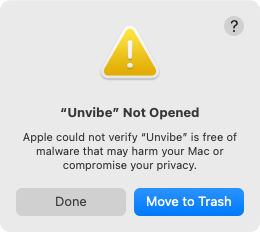
Real screen, macOS 15 - System Settings › Privacy & Security › Open Anyway. Confirm, then enter your Mac password. The button shows for about an hour after you try to open Unvibe.
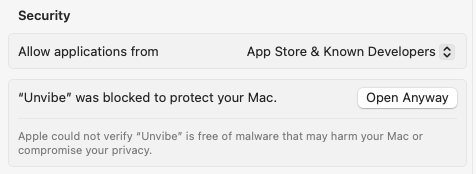
Real screen, macOS 15
The Terminal line checks the download against the published SHA-256 and Unvibe's self-signed signature before it installs anything. More help with the first open